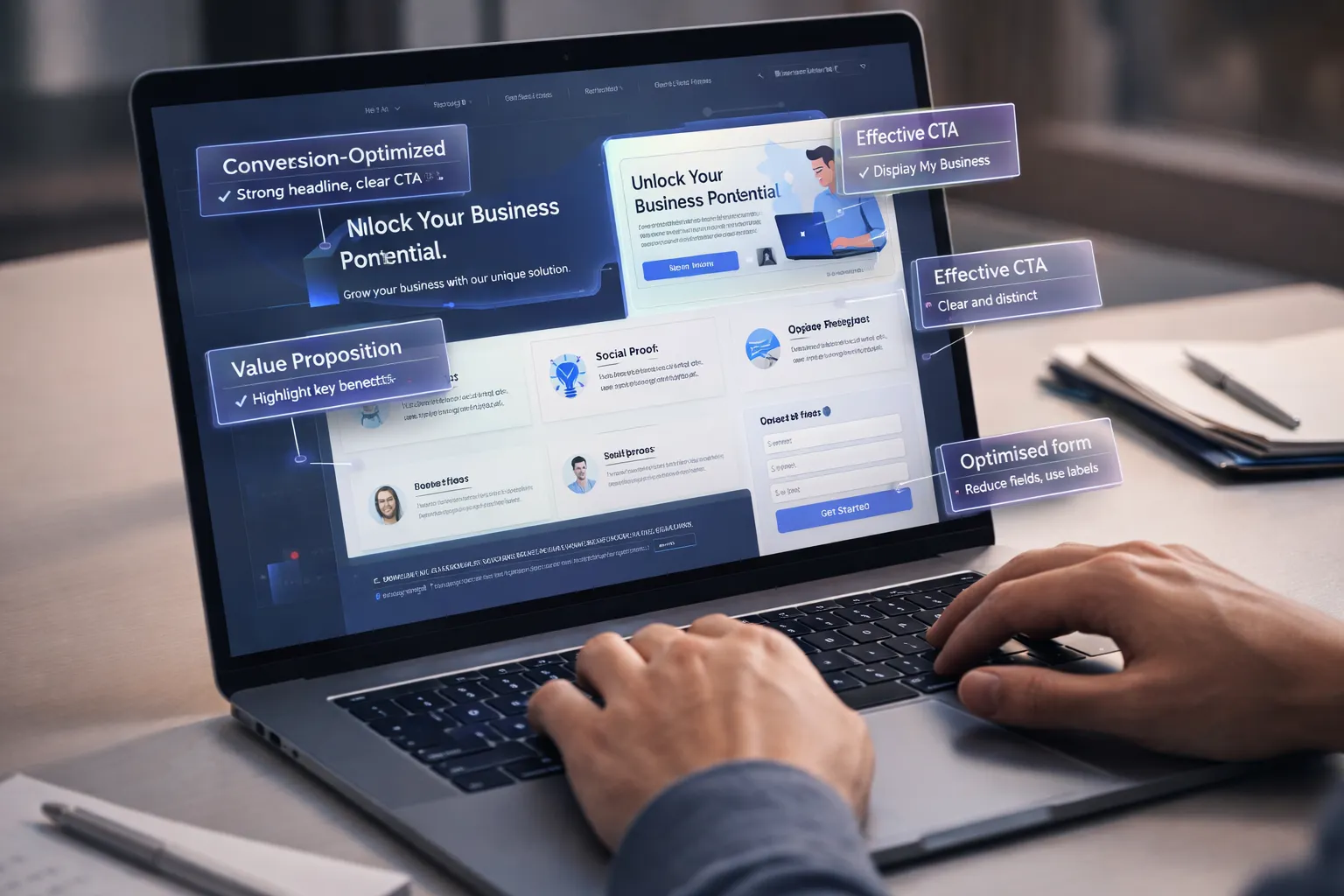
We've been analysing landing pages for a while now — clients' pages, our own, competitors' — and the same pattern keeps showing up: most fail at the same things.
Key takeaways
- A landing page that converts in 2026 needs a headline that explains the offer in 5 seconds, a load time under 2 seconds, mobile-first design, a short form, social proof next to the CTA and one primary button.
- The average landing page conversion rate is between 2.35% and 6.6% depending on the industry, and pages above 10% get there through systematic A/B testing.
- 82.9% of landing page traffic comes from mobile devices, so the page should be designed for phones first and then scaled up to desktop.
- Every extra second of load time costs about 7% of conversions, and 53% of mobile users leave a page that takes more than 3 seconds to load.
- Cutting form fields can raise conversions by up to 120%, and CTAs personalized to the traffic source convert 42% better than generic ones.
So we went through the latest data and recommendations from the leading voices in CRO and digital marketing. What we found is worth a full article.
If you're investing in paid traffic, this affects you directly. Because there's nothing more expensive than sending visitors to a page that doesn't convert.
First, the numbers you need to know
The average landing page conversion rate sits between 2.35% and 6.6%, depending on the sector. Pages that break 10% do exist — they're not magic, they're the result of systematic iteration.
82.9% of landing page traffic is mobile. If your page isn't built for mobile, you're losing the majority of your visitors. Companies with 40 or more landing pages generate 500% more conversions than those with fewer than 10. That's not a typo.
Only 17% of marketers actively run A/B tests, despite the fact that testing can drive up to 37% more conversions. That's a huge opportunity for those who do it.
1. A headline that answers 'what's in it for me?' within 5 seconds
It's the single highest-impact element for conversion. A well-written headline can triple the results of the exact same page.
Joanna Wiebe, founder of Copyhackers and one of the top references in conversion copywriting, puts it plainly: if someone who doesn't know your product can't explain your offer after reading your headline, you have a clarity problem that no amount of traffic will solve.
The 5-second test is brutal. And free: show your landing to someone who doesn't know it and ask them what you offer. If they hesitate, rewrite.
2. Page load time under 2 seconds
Every extra second costs you 7% in conversions. If your page takes 5 seconds to load instead of 2, you're systematically leaving conversions on the table.
53% of mobile users abandon a page that takes more than 3 seconds to load. Page speed is no longer a technical issue. It's a business issue.
3. Mobile-first design, not just mobile-friendly
There's a difference. "Mobile-friendly" means adapting something designed for desktop. "Mobile-first" means designing for mobile from the start.
With nearly 83% of traffic coming from mobile, the logical order is to design for mobile and scale up to desktop — not the other way around. Forms easy to fill with a thumb, CTAs large enough to tap, text readable without zooming in. These are basics that still fail on too many pages.
4. Short forms. Very short.
Reducing the number of form fields can increase conversions by up to 120%. That's not a small number.
The practical rule: ask only for what you need right now. If name and email is enough to start the relationship, don't ask for phone number, company name and job title. That can come later. Every extra field is a barrier. And when in doubt, people don't fill it in.
5. Social proof in the right place
It's not just about having testimonials. It's about where you put them.
CRO experts are clear: the best testimonial in the wrong place won't help at the moment of hesitation. Social proof needs to be before or next to your CTA — not buried at the bottom of the page.
Content visible above the fold gets 84% more attention. If your headline, CTA and trust signals aren't visible without scrolling, most visitors will leave before ever seeing them.
What type of social proof converts best in 2026? Testimonials with full name, photo and job title — not 'Ana G., happy customer'. Case studies with concrete, measurable results. Client or media logos if you have them. And video testimonials when page weight allows.
6. One clear CTA
The more options you give, the fewer conversions you get. It's the paradox of choice applied to marketing.
One landing page, one offer, one primary button. Neil Patel repeats it in every guide he publishes: the clarity of the CTA is directly proportional to the conversion rate.
The button text matters more than you'd think. "Submit" converts worse than "Get my free guide" or "Start today with no commitment". The CTA needs to speak the language of the benefit, not the technical action.
7. Personalised CTAs based on traffic source
Personalised CTAs convert 42% more than generic ones. If you have segmented traffic — by ad, audience, or source — and you're sending everyone to the same landing with the same text, you're wasting that segmentation.
In 2026 there are accessible tools for showing dynamic content based on traffic source. This isn't science fiction or something only big budgets can afford.
8. Systematic A/B testing, not one-off tests
The best results don't come from a perfect landing page. They come from dozens of iterative tests.
The problem is most people test once, see something isn't working, change five things at once, and have no idea what moved the needle. The rule: one variable per test, enough time for statistical significance, and decisions based on data — not gut feeling.
9. AI to iterate faster
AI-assisted landing pages have a conversion rate 37% higher than those written purely by humans. It doesn't mean AI does it better. It means it allows you to test more variations in less time. And in CRO, whoever tests the most, wins.
| Element | What to do | Impact according to the data |
|---|---|---|
| Headline | Explain the offer within 5 seconds | Can triple the results of the same page |
| Page speed | Load in under 2 seconds | Each extra second costs 7% of conversions |
| Form | Ask only for what you need now | Up to 120% more conversions |
| Above the fold | Headline, CTA and social proof visible on arrival | 84% more attention |
| Personalized CTA | Match it to the traffic source | 42% more conversions than a generic one |
| A/B testing | One variable per test, run continuously | Up to 37% more conversions |
Frequently asked questions
What is a good landing page conversion rate?
The average landing page converts between 2.35% and 6.6%, depending on the industry. Pages above 10% do exist, and they get there through continuous A/B testing rather than a single perfect design.
What is the best landing page structure in 2026?
Put a headline that explains the offer in 5 seconds, one primary CTA and social proof above the fold, since that area gets 84% more attention. Below it, add the offer details and a short form that asks only for what you need right now. Design it for mobile first, because 82.9% of landing page traffic is mobile.
How long should a landing page be?
Long enough to explain one offer and remove doubt, and no longer. What matters most is that the headline, CTA and social proof are visible without scrolling, because most visitors leave before reaching the bottom of the page.
What is the difference between a landing page and a homepage?
A homepage introduces the whole business and offers many paths, while a landing page is built around a single offer and a single action. That is why a landing page should have one clear CTA: the more options you give, the fewer conversions you get.
Need a landing page that actually converts? We build and optimise yours from scratch — design, copy, and analytics included.
Sources
- Hostinger – Landing Page Statistics 2026
- Involve.me – 100+ Landing Page Statistics
- SEO Sherpa – Landing Page Statistics 2026
- ALM Corp – Landing Page Optimization Guide 2026
- Brandedagency – Anatomy of a High-Converting Landing Page
- Unicorn Platform – Landing Page Conversion Optimization 2026
- KlientBoost – Landing Page Social Proof
- Apexure – Above the Fold Landing Page Design
- UserGuiding – CRO Statistics & Trends
- Neil Patel – High-Converting Landing Pages
- GenesysGrowth – 40 Landing Page Conversion Stats